

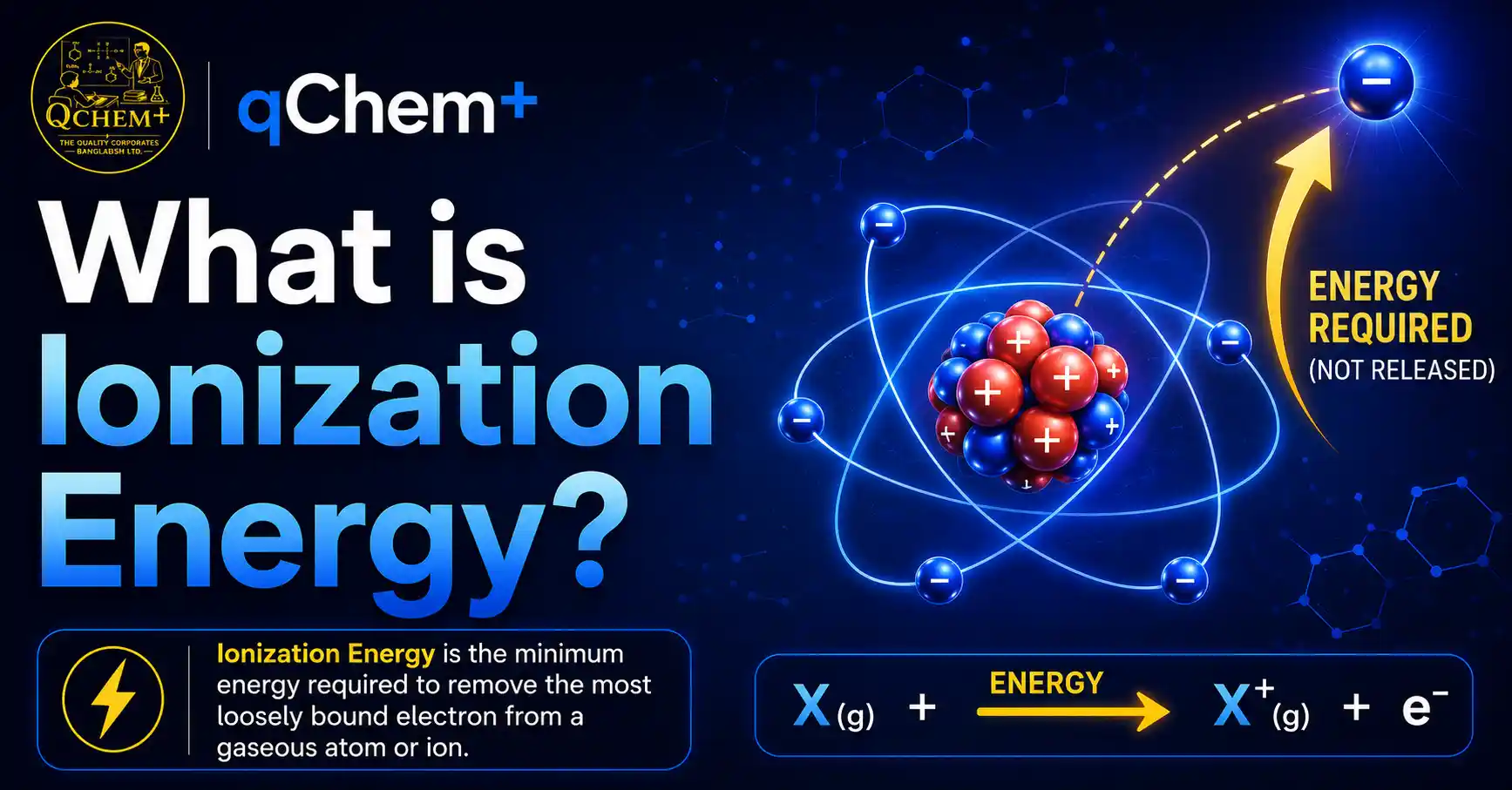
Many students make a mistake when asked:
“What is ionization energy?”
Let’s learn how to properly and correctly define ionization energy.
The amount of energy required to remove one mole of electrons from one mole of atoms or ions in the gaseous state to produce one mole of positive ions, is called ionization energy / ionization potential of the concerned element.
Symbol: IE
Unit: kJ/mol [Read: Kilojoules per mole]
Expression:
Official IUPAC definition of ionization energy
Successive Ionization Energies
First Ionization Energy
The amount of energy required to remove one mole of electrons from one mole of ground state atoms in the gaseous state to produce one mole of unipositive ions, is called first ionization energy of the concerned element.
It is called first ionization energy because it is the 1st electron removed from the outer / valence shell of the atom in its ground state.
Expression:
Second Ionization Energy
The amount of energy required to remove one mole of electrons from one mole of unipositive ions in the gaseous state to produce one mole of dipositive ions, is called second ionization energy of the concerned element.
It is called second ionization energy because it is the 2nd electron removed from the outer / valence shell of the atom in its unipositive ion state.
Expression:
M⁺(g) → M²⁺(g) + e⁻
Third Ionization Energy
Similarly it goes on like this.
Read more topics like this here
![What is Stereoisomerism? [1 Mark Q&A] – qChem+ chemistry featured image explaining stereoisomerism, compounds with the same molecular formula and connectivity but different three-dimensional arrangements, including geometrical, optical, and conformational isomerism for HSC, SSC, O Level, AS Level, and A Level Chemistry students.](https://qchemplus.com/wp-content/uploads/2026/09/What-is-Stereoisomerism-1-mark-QA-820x430.webp "What is Stereoisomerism – 1 mark Q&A")
![A detailed educational infographic titled "What is Mole Fraction?" for qChem+, defining it as the ratio of moles of a component to the total moles in a mixture, with a beaker illustration and formulas for components A, B, and C. It features the qChem+ logo from The Quality Corporates Bangladesh Ltd. and a "[1 Mark Q&A]" call-out.](https://qchemplus.com/wp-content/uploads/2026/09/What-is-Mole-Fraction-1-mark-QA-820x430.webp "What is Mole Fraction – 1 mark Q&A")
![What is Partial Pressure? [1 Mark Q&A] – qChem+ chemistry featured image illustrating partial pressure in a gas mixture, showing individual gas pressures and Dalton’s law of partial pressures for HSC, SSC, O Level, AS Level, and A Level Chemistry students.](https://qchemplus.com/wp-content/uploads/2026/06/What-is-Partial-Pressure-1-mark-QA-820x430.webp "What is Partial Pressure? | 1 Mark Q&A for Chemistry Students – qChem+")
![What is Enantiomer? [1 Mark Q&A] – qChem+ chemistry featured image illustrating enantiomers as non-superimposable mirror images with chiral molecules, stereochemistry concept, and optical isomerism for HSC, SSC, O Level, AS Level, and A Level Chemistry students.](https://qchemplus.com/wp-content/uploads/2026/06/What-is-Enantiomer-1-Mark-QA-–-qChem-The-Home-of-Chemistry-1-820x430.webp "What is Enantiomer [1 Mark Q&A] – qChem+ – The Home of Chemistry")
![What is Standard Enthalpy Change of Formation? [1 Mark Q&A] – qChem+ chemistry featured image explaining standard enthalpy change of formation (ΔH°f), showing the formation of one mole of a compound from its elements in their standard states for HSC, SSC, O Level, AS Level, and A Level Chemistry students.](https://qchemplus.com/wp-content/uploads/2026/06/What-is-Standard-Enthalpy-Change-of-Formation-1-Mark-QA-–-qChem-The-Home-of-Chemistry-820x430.webp "What is Standard Enthalpy Change of Formation [1 Mark Q&A] – qChem+ – The Home of Chemistry")
![What is Le Chatelier’s Principle? [1 Mark Q&A] – qChem+ The Home of Chemistry chemistry featured image illustrating chemical equilibrium, stress and shift, and reaction conditions like temperature, pressure, concentration, and catalyst for HSC, SSC, O Level, AS Level, and A Level students.](https://qchemplus.com/wp-content/uploads/2026/06/What-is-Le-Chateliers-Principle-1-Mark-QA-–-qChem-The-Home-of-Chemistry-820x430.webp "What is Le Chatelier’s Principle [1 Mark Q&A] – qChem+ – The Home of Chemistry")
![What is Electronegativity? [1 Mark Q&A] – qChem+ chemistry featured image explaining the ability of an atom to attract bonding electrons, with periodic table trends and electron pull illustration for HSC, SSC, O Level, AS Level, and A Level Chemistry students.](https://qchemplus.com/wp-content/uploads/2026/06/What-is-electronegativity-1-mark-QA-820x430.webp "What is Electronegativity? | 1 Mark Q&A for Chemistry Students – qChem+")
![Define Empirical Formula [1 Mark Q&A] – qChem+ chemistry featured image explaining the simplest whole-number ratio of atoms in a compound with molecular formula and empirical formula examples for HSC, SSC, O Level, AS Level, and A Level Chemistry students.](https://qchemplus.com/wp-content/uploads/2026/06/Define-empirical-formula-1-mark-QA-1-820x430.webp "Define Empirical Formula | 1 Mark Q&A for Chemistry Students – qChem+")
![What is Electron Affinity? or Define Electron Affinity. [1 Mark Q&A] – qChem+ The Home of Chemistry educational chemistry featured image showing an atom gaining an electron, electron affinity concept, and periodic table elements for HSC, SSC, O Level, AS Level, and A Level students.](https://qchemplus.com/wp-content/uploads/2026/06/What-is-electron-affinity-1-mark-QA-820x430.webp "What is electron affinity – [1 mark Q&A] – qChem+ – The Home of Chemistry")
![Define Ionization Energy [1 Mark Q&A] – qChem+ The Home of Chemistry educational chemistry featured image with atomic structure, electron removal concept, and ionization energy explanation for HSC, SSC, O Level, AS Level, and A Level students.](https://qchemplus.com/wp-content/uploads/2026/06/What-is-ionization-energy-1-mark-QA-820x430.webp "What is ionization energy – 1 mark Q&A")