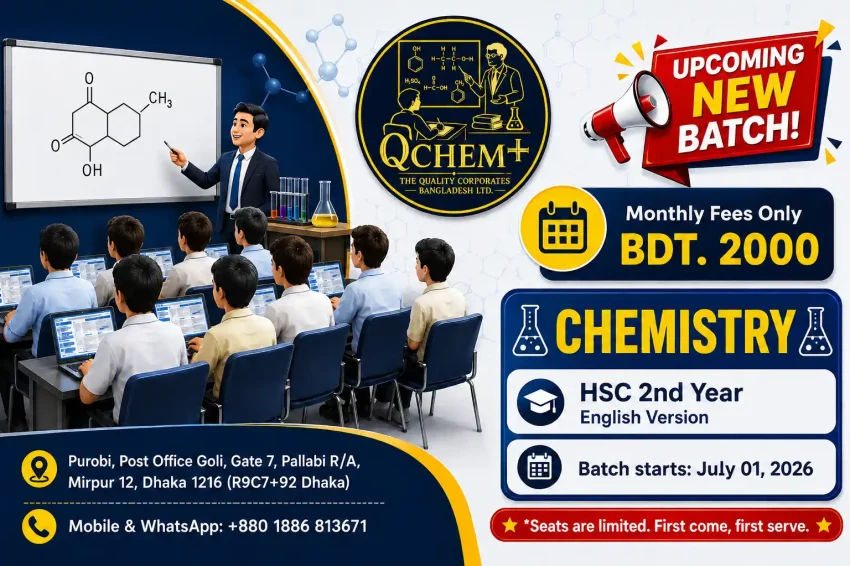
Prepare confidently for your HSC 2nd Year Chemistry (English Version) examinations with qChem+ — a modern and result-oriented chemistry coaching program located in Pallabi, Mirpur, Dhaka. This course is specially designed for HSC science students who want to strengthen advanced chemistry concepts, improve analytical problem-solving skills, and achieve outstanding results in board examinations. At qChem+, students receive structured and exam-focused guidance covering Physical Chemistry, Organic Chemistry, and Inorganic Chemistry through interactive classroom sessions, concept-based teaching methods, and intensive practice programs. The course focuses on simplifying complex chemistry topics, improving numerical solving techniques, and helping students develop confidence in tackling HSC board exam questions effectively. Students benefit from organized lecture materials, handwritten notes, regular class tests, revision sessions, CQ and MCQ solving practice, and continuous academic support in a focused learning environment. The teaching approach is designed to strengthen conceptual understanding while enhancing speed, accuracy, and exam performance.
Course Highlights:
- Complete HSC 2nd Year Chemistry syllabus coverage
- English Version chemistry coaching
- Advanced concept-building and problem-solving approach
- Topic-wise notes and exam-focused practice materials
- Regular exams, revision classes, and performance evaluation
- Board exam preparation with CQ and MCQ solving strategies
- Personalized academic support and mentoring
- Student-friendly and disciplined learning environment
- Taught by Rohan Ahmed, Lead Instructor at qChem+
- Convenient location in Pallabi, Mirpur, Dhaka
Whether you want to improve your chemistry fundamentals or prepare strategically for HSC board examinations, qChem+ provides a structured and supportive environment for academic success. Join the upcoming HSC 2nd Year Chemistry (English Version) batch at qChem+ and take your chemistry preparation to the next level with smart learning techniques and professional guidance.
HSC 2nd Year Chemistry Syllabus
Chapter One: Environmental Chemistry (25 Lessons)
Components of Atmosphere; Effect of Temperature, Pressure, Density and Humidity of Air to Form Cyclone and Tidal Waves;
Boyle’s Law, Charles’s Law, Avogadro’s Law, Gay-Lussac’s Law, Dalton’s Law of Partial Pressure and Graham’s Law of Diffusion;
Student’s Activity: Boyle’s and Charles’s Law Related Experiment; The Kinetic Theory of Gases;
Calculation of Kinetic Energy from Equation of Kinetic Theory, Ideal Gas and Real Gas;
Conditions of Real Gases to Follow Ideal Behaviour; Application of Gas Laws in Cylindering Gases;
Reaction in Atmosphere during Thunder Storm and Nitrogen Fixation in Soil; Gaseous Wastes of Industry and Air Pollution;
Sources of Greenhouse Gases and Greenhous Effect; Uses of CFC and Ozone Layer Depletion;
Causes of Acid Rain and Its Remedy, Student’s Activity: Analysis the Possibility of Acid Rain in an Arca; Arrhenius Theory;
Bronsted-Lowry Theory and Conjugate Acid-Base; Lewis Theory of Acid and Base; Source of Fresh Water and Its Importance;
Criteria of Purity of Surface Water (pH, DO, BOD, COD, TDS); Industrial Wastage and Water Pollution;
Searching the causes of Water Pollution and Its Prevention; Natural Pollution of Water-Arsenic Pollution and Its Remedy;
Causes and Effects of Heavy Metals (As, Cr, Pb, Cd) Addition into Food Chain;
Types of Solution and Dissolving Techniques of Pollutants in Air and Water.
Chapter Two: Organic Chemistry (40 Lessons)
Classification of Organic Compounds; Homologous Series; Functional Groups; Student’s Activity: Identification of the classes of organic compounds based on functional group;
Nomenclature of Organic Compounds; Isomerism in Organic Compounds and Its Classification;
Student’s Activity: Determination of Number of Isomers and Formula of Organic compounds from Their Chemical Formulae; Aromatic Hydrocarbons;
Difference between Aliphatic and Aromatic Compounds; Addition of Aliphetic and Aromatic Compounds (Electrophilic and Nucleophilic), Substitution (Electrophilic and Nucleophilic), Elimination and Rearrangement Reactions;
Multi Substitution Reactions and Orientation of Benzene; Alkane, Alkene, Alkyne, Alkyl/ Aryl Halide, Alcohol, Ether, Aldehyde, Ketone, Carboxylic Acid, Ester, Amine and Amide;
Practical: Identification Test of functional groups Like- OH(alc), X, CHO, > CO, – COOH;
Identification of functional groups $(-OH, >C=O)$ by IR spectroscopic Absorption/Emission Band; Preparation of Glycerine and Phenol and Their Identification Reactions;
Preparation and Uses of Nitroglycerine, TNT, Dettol, Paracetamol; Role of Melting Point and Boiling Point of Organic Compounds in Purity and Identification Tests;
Practical: Student’s Activity: Determination of Melting and Boiling Points of An Organic Compound; Polymer and Plasticity;
Addition and Condensation Polymerisation Reaction; Glycosidic and Peptide Bond in Polymer Molecules;
Student’s Activity: Importance of Organic Compounds in the Field of Consumer Products, Home Applicances, Medicines etc. Role of Organic Compounds in the Field of Environment and Society;
Student’s Activity: Advantages and Disadvantages of Uses of Polythene and Formalin.
Chapter Three: Quantitative Chemistry (22 Lessons)
Chemical Calculation and Molar Volume of Gas; Determination of Volume of Gaseous Product from Chemical Equation;
Determination of Mass and Volume of Gaseous Product from the Amount of Reactant;
Practical: Student’s Activity: Determination of Volume of Gaseous Product of a Reaction; Practical: Preparation of Solution of Molar Concentration;
Conversion of Molarity into Percentage and ppm Unit; Practical: Dilution of Concentrated Solution; Acid-Base Neutralization Reaction and Its End Point;
Redox Reactions; Oxidation-reduction Half-Reaction; Practical: Student’s Activity: Determination of End Point of Acid- Base, Reaction by Using Indicators;
Practical: Student’s Activity: Determination of the Amount of Acid or Alkali in Unknown Solution by Tritration;
Practical: Determination of the Amount of Metallic Ion Contained in Solution by Oxidation-Reduction Titration: Practical: Student’s Activity: Determination of the Amount of
FeSO4 in Solution by Using 0.01 M KMnO4 Solution; Uses of the Beer-Lambert Law in Determining the Concentration of Solution;
Principles of Quantitative analysis of Atomic Absorption Spectrophotometry (AAS), UV-Visible Spectroscopy, HPLC and GC.
Chapter Four: Electrochemistry (28 Lessons)
Electrical Conductor and Its Classification; Conductivity of Electrolyte; Practical: Student’s Activity: Experiment on the Conductivity Difference of Various Electrolytic Solutions;
Determination of Quantity of Electrolyte by Applying Faraday’s First Law; Reactivity Series of Metals;
Practical: Student’s Activity: Experiment on the Relative Reactivity of Metals; Oxidation Half-Reaction and Reduction Half- Reaction; Electrode Potential;
Electrode Potentials and Reactivity series of Metals; Redox-Reaction; Cell Potential and Standard Cell Potential;
Nernst Equation for Potential of Electrodes and Cell; Electrode and Its Classification: Practical: Student’s activity: Construction of Metal-Metal Ion Electrode: Practical : Student’s Activity: Conversion of Chemical Energy into Electrical Energy by Forming Cell;
Construction of Electrochemical Cell Containing Single and Double Chamber (Electrolytic and Galvanic);
Construction, Function and Recharging Process of Rechargeable (Lead Storage and Lithium) Batteries;
Advantages and Disadvantages of using Lead Storage and Lithium batteries; Fuel Cell and Its Types;
Fuel Cell’s Anode, Cathode and Fuel; Construction of Hydrogen Fuel Cell and Its Cell Reactions; Advantages of Hydrogen Fuel Cell;
Technique of pH Determination of Solution by pH Meter.
Chapter Five: Economic Chemistry (25 Lessons)
Natural Gas Fields of Bangladesh, Components and Uses of Natural Gas; Coal Fields of Bangladesh, Quality and Uses of Coal;
Possibility of Industrialisation in Bangladesh with respect to Fuel Resources; Introduction to Important Chemical Industries in Bangladesh;
Principle of Urea, Glass, Ceramic, Pulp-Paper and Cement Production; Principle of Leather Tanning;
Description of Pollutants of Different Industries Like Cement. Urea, Leather, Textile and Dyeing;
Working Principle of ETP (Electrolysis, Catalysis and Biotechnology); Mechanism of Controlling Air Pollution (Catalytic Conversion, Dissolving Pollutants and Fine Particles Filtration);
Working Principle of ETP (Electrolysis, Catalysis and Biotechnology); Recycling Process of Iron, Aluminium, Copper, Glass, Paper and Plastic;
Importance of Recycling of Iron, Aluminium, Copper, Glass, Paper and Plastic Materials in Social and Environmental Fields;
Student’s Activity: Preparation of Report Based on the Observation of Air Pollution in Brick Fields;
Advantages and Disadvantages of Coal- Based Power Plant; Preliminary Concept of Nanoparticles and Nanotechnology; Comparison among Atom, Molecule and Nanoparticle;
Comparison of Physical Properties between Nanoparticles and Normal State of Matter; Probability of Application of Nanoparticles in Industry.
Course Features
- Duration 50 Weeks
- Activities Chemistry
- Class Sizes 20
- Time 17:00 - 18:30
- Day of week Sun, Tue, Thu
- Available Seats 11