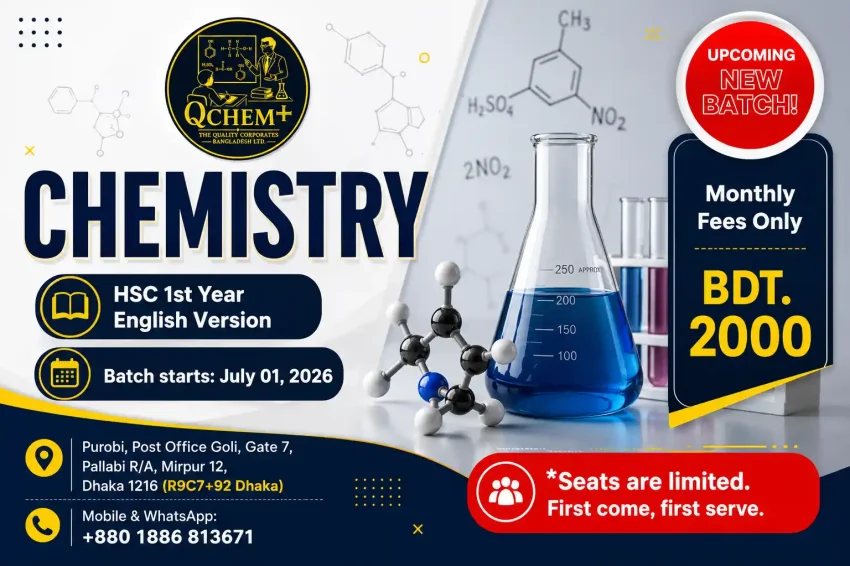
Prepare confidently for your HSC 1st Year Chemistry (English Version) examinations with qChem+ — a modern and student-focused chemistry coaching program located in Pallabi, Mirpur, Dhaka. This course is specially designed for HSC college level students in Dhaka who want to build strong concepts in Chemistry, improve problem-solving skills, and achieve excellent academic results in their HSC Chemistry exams. At qChem+, students receive structured guidance covering Physical Chemistry, Organic Chemistry, and Inorganic Chemistry through interactive classes, concept-based learning, and exam-oriented practice sessions. The course emphasizes clear understanding of fundamental topics, smart solving techniques, and effective preparation strategies for college assessments and board examinations. Students benefit from carefully prepared notes, regular class tests, revision sessions, practical examples, and continuous academic support in a focused learning environment. The teaching approach is designed to help students overcome fear of chemistry, strengthen analytical thinking, and perform confidently in exams.
Course Highlights:
- Complete HSC 1st Year Chemistry syllabus coverage
- English version Chemistry coaching
- Concept-building and problem-solving approach
- Structured class notes and practice materials
- Regular exams and revision sessions
- Academic support and performance monitoring
- Small batch interactive learning environment
- Taught by Rohan Ahmed, Lead Instructor at qChem+
- Convenient location in Pallabi, Mirpur, Dhaka
Join the upcoming HSC 1st Year Chemistry batch at qChem+ and strengthen your chemistry foundation with professional guidance, organized preparation, and exam-focused learning.
Syllabus Coverage:
Chapter One: Safe Use of Laboratory (Number of Lessons / Classes – 5)
- Rules of Laboratory Use: Dress, Safety Glass, Mask and Hand Gloves;
- Safe Way of Using Glassware;
- Techniques of Cleaning of Laboratory Equipments and Glasswares;
- Scope and Terms of uses of Paul-Bunge Balance, Digital Balance (2-digit and 4-digit), Measuring Cylinder, Burette, Volumetric Flask and Pipette;
- Techniques of Use of Conical Flask, Wash Bottle, Burette and Pipette;
- Techniques of Heating the Test Tube, Beaker, Round-Bottomed Flask, Conical Flask, Porcelain Vessels or Water Bath by Spirit Lamp or Bunsen Burner;
- Techniques of Using Reagent Bottle;
- Precautions in Storing and Using Chemicals;
- Safe Storing and Disposal of Used Chemicals;
- Effect of Laboratory Chemicals on Environment and the Importance of Using Them in Moderation;
- Semi-micro and Micro Analytical Methods;
- Laboratory Safety Equipments and Its Using Process;
- Primary Treatment and Using Process of First-Aid Kit.
Chapter Two: Qualitative Chemistry (Number of Lessons / Classes – 32)
- Rutherford’s and Bohr’s Atomic Models;
- Quantum Numbers;
- Different Subshells and Their Electron Containing Capacity;
- Order of Energy of Quantum Subshells and Shapes of Orbital;
- Aufbau, Hund’s and Pauli’s Exclusion Principle;
- Electromagnetic Spectrum.
- Student’s Activities: Identification of Elements Using Line Spectrum
- Bohr’s Atomic Model and Hydrogen Atomic Spectrum
- Use of UV-Ray to Detect Fake Passport/CurrencyUses of IR-Ray in Medical Treatment
- Basic Principle of MRI for the Diagnosis of Diseases
- Practical: Identifying Na, K, Ca²⁺ and Cu²⁺ ions by Flame Test
- Solubility, Solubility Principle and Solubility Product
- Detection of Cu2+, Al³⁺, F2³⁺, Fe³⁺, Zn²⁺, Ca²⁺, Na⁺, NH₄⁺, Cl⁻, SO₄²⁻, CO₃²⁻
- Crystallisation
- Student’s Activity: Production of Pure Salt Crystal from Edible Salt
- Distillation and Fractional Distillation, Steam Distillation and Sublimation;
- Primary Concept of Chromatography;
- Separation of Compound from Mixture (Chalk/Filter Paper) by Chromatography;
- Importance of Qualitative Analysis.
Chapter Three: Periodic Properties and Chemical Bonding of Elements (Number of Lessons / Classes – 30)
- Classification of Elements Based on Electronic Configuration;
- General Properties of Elements of Different Groups.
- Periodic Properties: Melting Point and Boiling Point, Size of Atoms, Valency, Ionization Potential, Electron Affinity, Electronegativity, Metallic Properties.
- Effect of Different Factors (Atomic size, Subshell, Electronic Configuration) on Ionization Potential, Electron Affinity and Electronegativity.
- Properties of Oxides of Elements (Acidic and Basic Oxides).
- Practical / Student Activities: Determination of Acid-base Characteristics of Soluble Oxides
- Relationship between Periodic Properties and Chemical Bonds
- Overlapping of Orbitals
- Different Types of Covalent Bond
- Hybridization and Types of Hybridization
- Relationship between Hybrid Orbitals and Shape of Covalent Molecules
- Effect of Lone Pair Electrons on Shape and Bond Angle
- Making Different Structure of Compounds Using Simple Materials
- Co-ordinate Covalent Bond
- Comparison between Co-ordinate Covalent Bond and Covalent Bond
- Polarity and Polarization.
- Practical: Identification of Dipole in Water by Experiment
- van der Waals Force; Hydrogen Bond.
- Student Activities: Comparison of H₂O and H₂S Bond
- Importance of Hydrogen Bond
- Nomenclature of Inorganic Compounds.
Chapter Four: Chemical Changes (Number of Lessons / Classes – 28)
- Chemical Reactions and Green Chemistry;
- Direction of Reaction – Irreversible and Reversible Reactions.
- Rate of Reaction: Effect of Heat, Pressure and Concentration on Rate.
- Catalyst and Its Classification; Effect of Catalyst on Rate.
- Chemical Equilibrium and its Characteristics; Principle of Le Chatelier; Effect of Temperature, Pressure and Concentration on Equilibrium.
- Application of Le Chatelier Principle in Industrial Production.
- Law of Mass Action; Derivation of Mathematical Equation of K and Kc; Relation and Significance between K and Kc.
- Ionic Product of Water (Kw); Dissociation Constant of Acid (Ka) and Base (Kb); Dissociation Constant and Strength of Acids and Bases.
- pH and pH Scale; Buffer Solution and Preparation; Mechanism of Buffer Solution.
- Practical / Student Activities: Preparation of Carbonate Buffer Solution and Proof of Its Effectiveness
- pH in Human Blood
- Importance of pH in Agriculture, Chemical Industries, Toiletries and Medicine
- Selection of Suitable Personal Care Products by Measuring pH
- Heat of Neutralisation of Strong Acid and Strong Base;
- Bond Energy and Heat of Reaction.
- Lavoisier and Hess’s Law;
- Determination of Heat of Reaction.
- Practical: Determination of Heat of Solution of Oxalic Acid using Calorimetry.
Chapter Five: Vocational Chemistry (Number of Lessons / Classes – 35)
- Food Safety and Chemistry;
- Food Preservation Techniques with Permitted Preservatives.
- Principles of Canning (Local fruits, Vegetables – Bamboo Shoots, Tender Maize, Green Peas, Fish, Meat – Raw/Cooked); Various Steps of Canning.
- Practical / Student Activities: Canning of Foods
- Suspension and Coagulation
- Constituents Percentage of Milk
- Butter Separation from Milk
- Dewatering of Butter
- Ghee Production from Butter
- Toiletries and Perfume Production Techniques (Rose Water, Hair Oil, Talcum Powder, Vanishing Cream, Cold Cream, Lipstick, After Shave, Henna).
- Production of Glass Cleaner and Toilet Cleaner; Cleaning Techniques.
- Practical: Vinegar Production
- Project: Production of Malt Vinegar
- Techniques of Food Preservation by Vinegar; Importance of Vinegar.
Course Features
- Duration 08 Months
- Activities Chemistry
- Class Sizes 20
- Time 17:00 - 18:30
- Day of week Sat, Mon, Wed
- Available Seats 16